
I have learned one key concept from Amartya Sen when he recently spoke at the Ritz in Chicago, he said, “we need someone to force us to think about issues.” What a simple concept to consider, yet so true and straight to the point. How often do we get consumed within our own lives and forget about others?
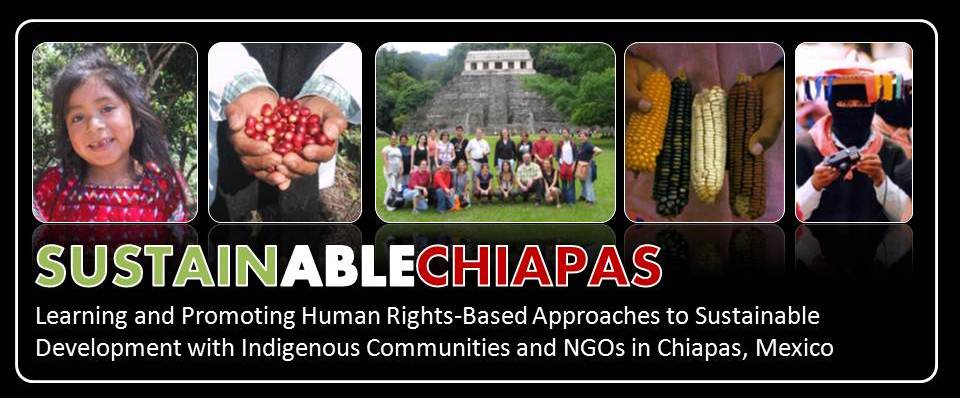
When I think of Sen’s comment, it takes me back to Chiapas. I think of sustainable development and our own purpose within the concept. What did we gain from this trip? The influence of our own society is taking its toll on the traditional culture, or even just changing it to cater to the new “revised” culture. The overwhelming influence of Coca-Cola in Chamula (as well as the State in general) represents more than just “pop” culture (no pun intended); it represents an international phenomenon so deeply woven into the indigenous culture that it has become a way of life most of us can not compare to. The use of Cola-Cola (and the bottles themselves) for everyday drinking, for weddings, for religious ceremonies, for medicinal purposes, and to venerate the dead, has led to a society that has become dependent on it but now is it finally seeing the adverse health affects of not drinking water (www.ciepac.org).
Did it take a few thousand empty bottles carefully placed on graves for me to “think about the issues?” It creates a sadness inside my heart. How can this feeling be changed?
My experience in Chiapas is one that I struggle with. While learning a lot about sustainable development in many different ways, I had positive experiences throughout the trip, but I struggled, and continue to struggle internally with my perspective on what is going on there. I don’t know how to make it right, and maybe I never will. Maybe another trip is necessary to help solve the confusion I feel after spending time in communities that make little progress in their struggle, visiting cooperatives where women learn to carry on traditions of the past while integrating the future into their weave of life, listening to the stories of a tamale seller at 630Am in the town square, and seeing children, who walk from hours away, go to school to learn without a single book to look at.

As outsiders, how can we help be a part of the change? Can we help them sustain their indigenous culture and integrated lifestyles by supporting those students that are not supported by their own government? A government that supports internationalism to the extreme, yet within these communities is unwilling to help their own future (children) be educated. Instead they knowingly (or not) contribute to the failure of their own future generations.
Can we support a library in these communities that will encourage them to be educated in the basic knowledge that will help them to lead superior lives, supporting their fight for the right to have a voice. Voices that understand the history of their own past, present, and future so that they will either have a voice in their future, or will be left behind to suffer as they continue to be denied their human right to a better life. Can we make a difference without being one of those “international” groups just wanting to help the poor voiceless people?
Now that we are back, we need to rethink what we’ve learned, and decide what we really want to get out of the trip. I want to say that we did something that makes a difference in the life of at least one person in Chiapas. Amartya Sen says it best, “ We, women and men must take responsibility for doing things or not doing them. It makes a difference, and we have to take note of that difference. This elementary acknowledgement, through simple enough in principle, can be exacting in its implications, both for social analysis and for practical reason and action” (Sen 1999, 190).
Who or what does it take for you to think and become active about the issues we are learning about? A teacher, volunteering, seeing homeless people sleep on the sidewalk, or a trip a few thousand miles away to see a disadvantaged community? For me, it was empty Coca-cola bottles on a grave. It was seeing “the future” wrapped in a shawl on a woman’s back, it was seeing hundreds of children lined up, sweating in the sun as some gringos exchange curious glances with them. Which would you rather do, use our degrees and get to work, or forget about it now and go back to our everyday lives of being “better off.” Choose wisely, because: 1. Children are the future, and 2. Someone might be listening to you as you talk about the issues.

http://www.ciepac.org/boletines/chiapas_en.php?id=437
By Elizabeth Hall


